Hallmark vs Impeccable vs Taste Skill: five blind judges, then twelve real builds
I had five AI judges score three anti-slop design skills from their code, then ran each one on three briefs with Opus 5.5. Screenshots, costs and a verdict.
Ask a coding agent for a landing page with no other guidance and you know what you’ll get: a dark hero, a tracked-caps label above a bold headline, two store buttons and a phone mockup on a teal glow. Three popular skills promise to stop that: Hallmark from Together AI, Paul Bakaus’s Impeccable and Taste Skill. Between them they have about 265,000 GitHub stars.
I tested them twice. First, five AI judges read all three repos and scored them in ten categories, with none of them seeing another’s scores. All five ranked them the same way: Impeccable, then Hallmark, then Taste Skill. The judges only read code, though, so then I did the part they couldn’t: I gave Claude Opus 5.5 three briefs, ran each one with no skill and with each skill in turn, and screenshotted all 12 results.
The short version: Impeccable made the most original page in all three tests, but it was also the most expensive of the runs that finished, at about 21 minutes and $6 a page. Hallmark cost about $3.60 and 10 minutes, kept closest to the facts in the brief and passed its own browser lint every time. Taste Skill made the weakest page for the wine bar, and its Tidewell run was still fixing things when my two-hour cap stopped it.
Why these three
They do the same job in different ways.
Hallmark is a page builder for new pages. It deals three themes from a catalog of 50 (each one a material file of at most 8 KB with a picture of a finished page), builds the page around the visitor’s job, then lints it in a real browser at eight widths. Its gates come in tiers. The Floor never ships (contrast, focus, reduced motion, invented facts, a broken phone layout), Reflex gates catch model habits and can be overruled on the record, and Finish checks are craft that never blocks.
Impeccable is a design vocabulary of 24 commands: critique, audit, polish, bolder, quieter, harden, live and the rest. init writes a PRODUCT.md and document writes a DESIGN.md, so later commands respect a design system that already exists. A Rust detector with 62 rules (I counted the entries in antipatterns.json) runs on source or on a rendered page, as an edit hook, in CI and in a Chrome extension. Its own README calls new builds “that harder mode”.
Taste Skill (tasteskill 2.5.0) builds company websites at “the figma.com and x.ai level”. Every page starts from one starter file with one section per screen, real photos and brand icons, and shader effects only for tech, gaming and software pages. A browser checker of 10,140 lines runs its rules at five widths. Version 2.5.0 was a full rebuild, released the day before my snapshot.
How the judges scored them
The method
I cloned all three repos on 6 November 2026 and pinned them: Hallmark at 407fa68, Impeccable at c3bb418 and Taste Skill at 9b4bf93. Each judge got the same rubric: ten categories scored 1 to 10, where 5 is adequate and 8 is excellent, plus an overall score that is a judgement, not an average. The repos were untrusted data. Judges could read files and run read-only commands, but not install scripts.
There were five judges, and none saw another’s scores:
- three separate Claude Opus 5.5 subagents (A, B and C)
- DeepSeek V4.1 Flash at max reasoning
- Muse Spark 1.3 Contributor at xhigh
They read code, docs, tests and examples, and some ran Hallmark’s tests and linter on its own fixtures. None of them ran a skill end to end, so the design quality score was a guess about what a build would look like. Every judge put their confidence at medium.
The scores
Mean of five judges, with the range in brackets. The best score in each row is bold.
| Category | Hallmark | Impeccable | Taste Skill |
|---|---|---|---|
| Output design quality | 8.2 (8–9) | 7.3 (7–8.5) | 7.0 (6–9) |
| Anti-slop enforcement | 8.2 (8–9) | 8.9 (8.5–9) | 6.7 (6–7.5) |
| Skill and prompt engineering | 7.6 (7–9) | 7.9 (6–9) | 5.9 (5–8) |
| Scope and versatility | 6.7 (6–7.5) | 9.3 (9–10) | 4.4 (3–6) |
| Fit in a real product codebase | 5.9 (5–7) | 8.9 (8–9.5) | 3.4 (2–5) |
| Compatibility and installation | 7.0 (7–7) | 9.1 (8–10) | 5.9 (5–6.5) |
| Engineering quality | 6.7 (6–7.5) | 9.3 (9–10) | 4.7 (4–5.5) |
| Evidence and evaluation | 6.8 (5–9) | 7.3 (6–9.5) | 3.6 (3–5) |
| Documentation and onboarding | 7.5 (6–8.5) | 7.8 (7–9) | 6.2 (6–7) |
| Project health and trajectory | 6.7 (6–7.5) | 8.3 (8–9.5) | 6.4 (5–8) |
| Overall | 7.4 (7–8) | 8.5 (8–9) | 5.6 (4–7) |
Hallmark won one category, design quality. Impeccable won the other nine. Taste Skill won none.
The overall scores per judge show how much the two outside models differed from the Claude judges, and how little that changed the order:
| Judge | Hallmark | Impeccable | Taste Skill |
|---|---|---|---|
| A (Opus 5.5) | 7 | 8.5 | 5 |
| B (Opus 5.5) | 7 | 8 | 5 |
| C (Opus 5.5) | 7 | 8 | 4 |
| DeepSeek V4.1 Flash | 8 | 9 | 7 |
| Muse Spark 1.3 | 8 | 9 | 7 |
DeepSeek and Muse scored higher overall. The biggest single split was on evidence: Muse gave Hallmark a 9 and called its eval harness “the only honest harness”, while Claude judge B gave it a 5. I side with the 5, because Hallmark’s eval results aren’t in the repo (more below). Muse also gave Taste Skill a 9 for design quality, against a 6 from each Claude judge.
The tests
Setup
Each test is one brief, run four times with claude-opus-5-5 in Claude Code 2.1.319 at high effort: once with no design skill and once with each skill. That’s 12 runs. Every run got the brief word for word plus the same closing lines:
Work non-interactively: do not ask me questions. Where something is missing, make a reasonable choice and say what you chose. Output a static site in this folder, with index.html at the root, that opens in a browser with no build step.
For a skill run, the prompt starts with that skill’s entry point and nothing else changes: /hallmark, /impeccable or /design-taste-frontend. Taste Skill’s README only says to ask your agent for a site, so I used its install name, which is how Claude Code exposes a skill as a command.
Isolation took more work than I expected. My machine has user-level skills, Impeccable among them, and a CLAUDE.md full of writing rules. Each run got an empty folder, its own HOME and CLAUDE_CONFIG_DIR, no plugins, hooks or MCP servers of my own, and only the skill under test, installed at project level from the pinned clone.
My first smoke test still loaded all my personal skills, and strace showed the CLI reading ~/.claude/skills and ~/.claude/CLAUDE.md with HOME pointed somewhere else. Claude Code also looks for .claude folders and CLAUDE.md in the parent folders of the working directory, and my home folder is a parent of my scratch folder. Moving the runs to /var/tmp fixed it. If you test skills this way, check the init event before you trust a run.
Claude Code 2.1.319 also bundles a dataviz skill that triggers on the word “dashboard”, so I set CLAUDE_CODE_DISABLE_BUNDLED_SKILLS=1 for every run, baseline included. The init event of each run lists what it loaded, and I kept all 12. Each one shows only its own skill, plus Claude Code’s built-in design, doctor and plugin-authoring entries, which were the same in every run.
Three more details:
- Install. Hallmark and Taste Skill are copies of their skill folders. Impeccable’s installer downloads release 4.8.0, which is 87 commits behind the pinned commit, so I copied the pinned build instead: the skill, its four agents, its design hook and the engine binary, which matched the checksum in the repo.
- Concurrency. Six runs went at once. With several headless Chromes running, the load on the 8-core VM reached 25, so the wall times below include contention.
- No cherry-picking. One run per cell, with a two-hour cap on each. No run crashed or broke isolation, so there were no reruns. One run hit the cap, and that’s its result.
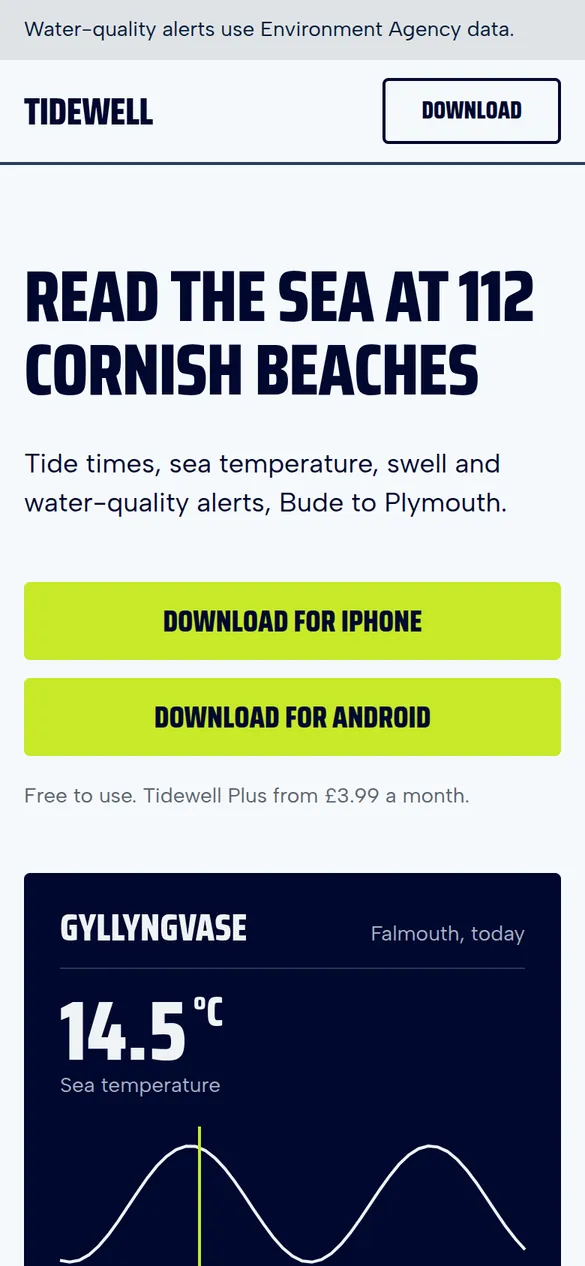
Screenshots use one fixed setup for all 12: headless Chrome 156 through puppeteer-core 24.43, each folder served over local HTTP, then a wait for network idle, fonts and 2.5 seconds. The main image is the first screen at 1440×900. Click it for the full page, captured at 1440 wide, which I captured after scrolling to the bottom and back so that scroll-triggered sections could appear. The phone link is the first screen at 390×844.
Test 1: a landing page for a swimming app
Build the landing page for Tidewell, a phone app for open-water swimmers in Cornwall. It shows tide times, sea temperature, swell and water-quality alerts for 112 beaches from Bude to Plymouth, and has a “swim buddy” check-in that texts a friend if you have not checked out of the water by a set time. Water-quality data comes from the Environment Agency. Free to use; Tidewell Plus is £3.99 a month or £29 a year and adds 7-day forecasts and buddy check-ins. Available on iOS and Android. The page should get people to download the app.
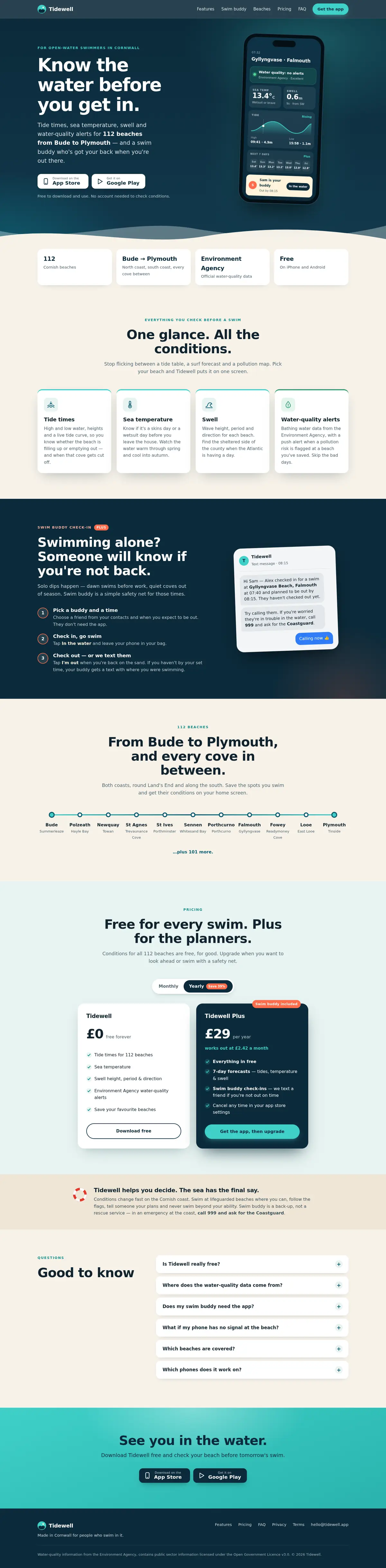
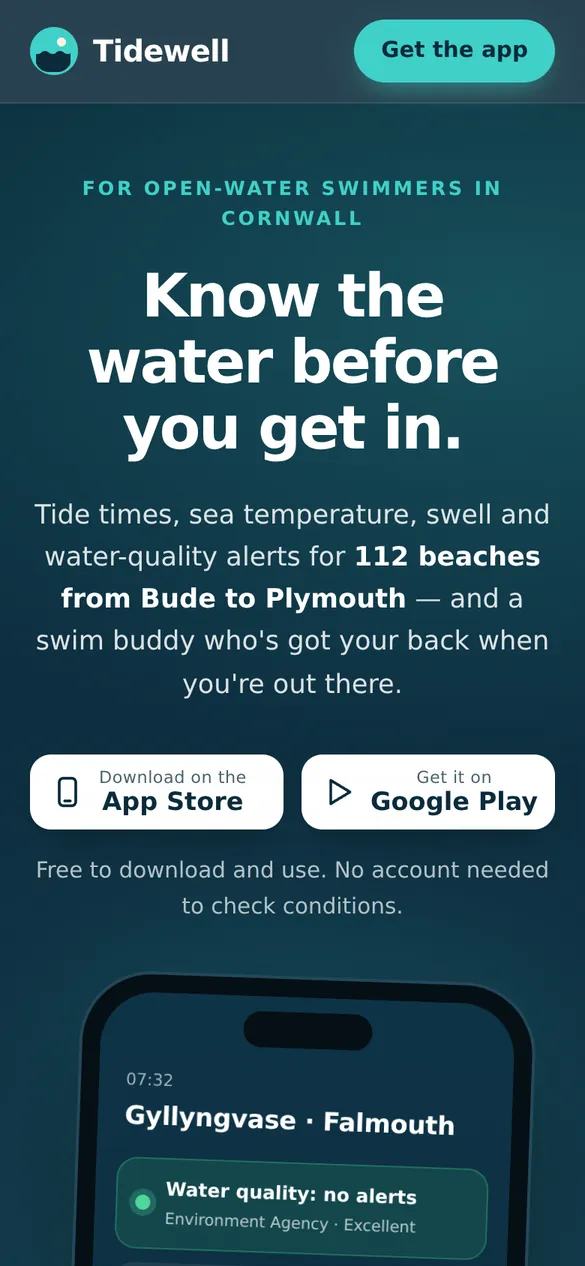

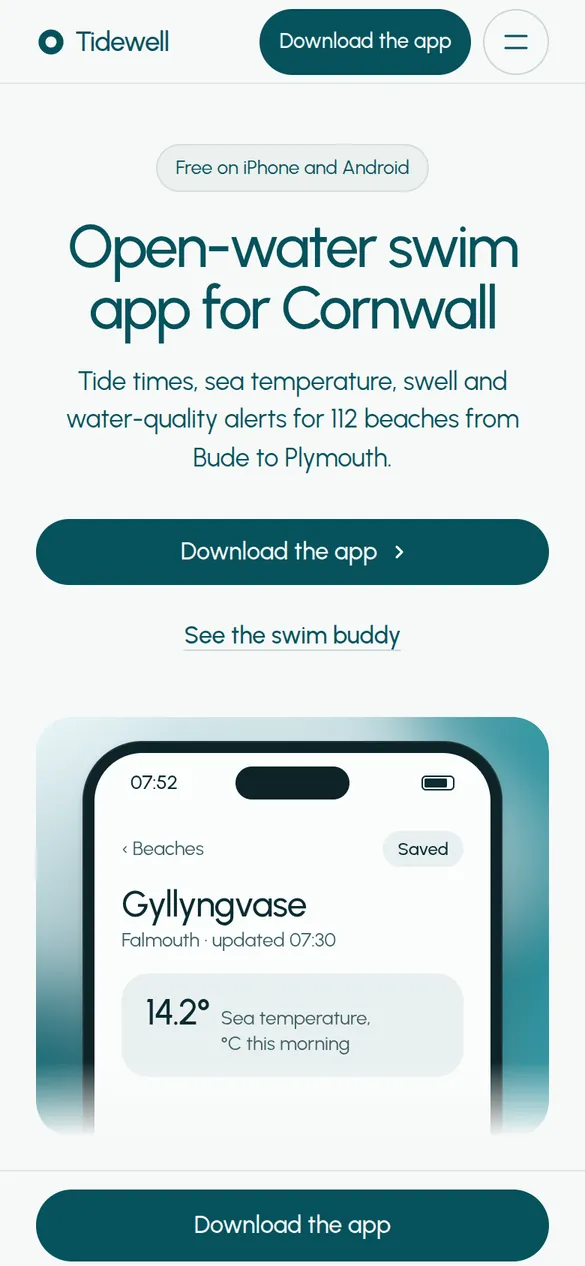
Opus 5.5 alone made exactly the page I described at the top: dark teal, a tracked-caps label, “Know the water before you get in.”, store buttons and a phone mockup with a tide curve, over a wave. It’s a complete page, with features, a swim buddy section, a beach line from Bude to Plymouth, pricing with a monthly and yearly switch, a safety note and an FAQ, all in 4 minutes 25 seconds for $1.16. It just looks like every other app page.
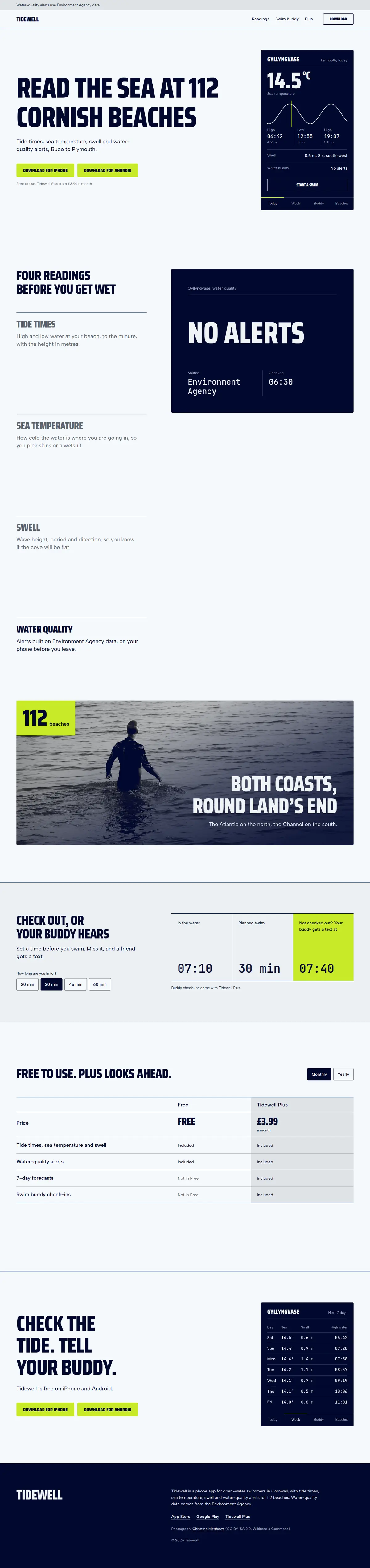
Hallmark dealt itself a sport theme: condensed navy capitals (“Read the sea at 112 Cornish beaches”), lime buttons for iPhone and Android, and an app panel built in HTML with sample readings for Gyllyngvase. The swim buddy section is a working control: pick how long you’ll swim and it shows when your buddy would get the text. Its one photo is a weak spot. It’s a library picture of a swimmer at Leigh-on-Sea, which is in Essex, on a page about Cornwall. Hallmark did credit it and list it as a stand-in to replace.
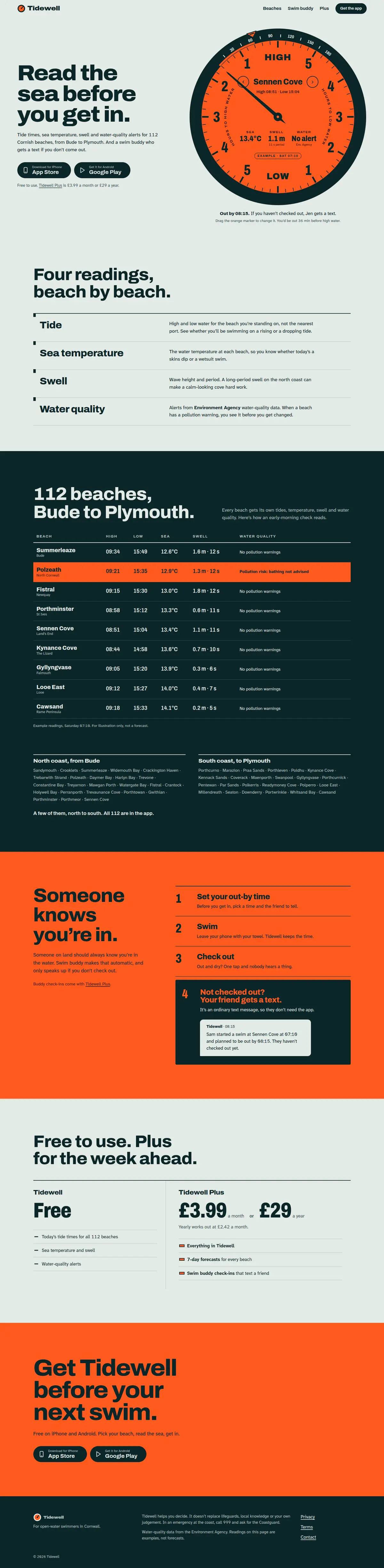
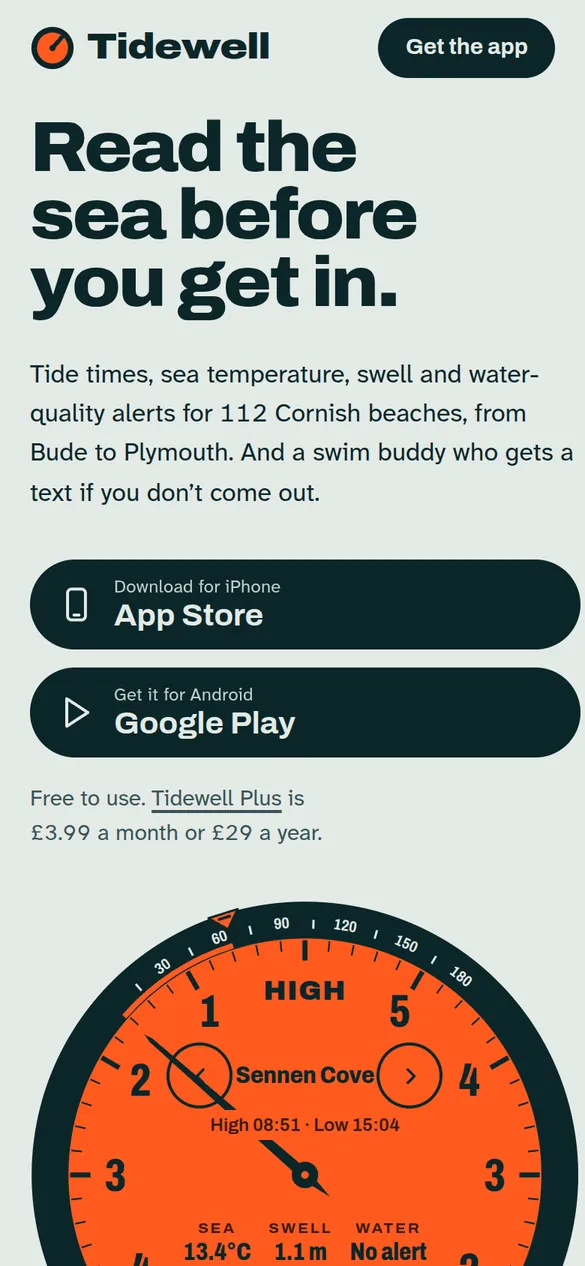
Impeccable built the whole first screen around one object: a working tide clock. It’s a big orange dial whose hand shows the state of the tide at nine example beaches, with the times, sea temperature, swell and Environment Agency status on its face. You set your “out by” time by dragging a marker round the bezel, and the example text message further down the page updates to match. It’s the only Tidewell page I’d remember the next day. It also chose 48 beach names for a coast list and told me to check them against the real 112.
Taste Skill classed Tidewell as software, so it got effects: a gradient-mesh shader behind two phone screens, painted card backgrounds and counters that roll up. It found a real photograph of Porthcurno on Wikimedia Commons (CC BY-SA) because its library has nothing from Cornwall. The page is polished, but its first screen is the closest of the three skills to the generic look, with a pill label above a centred headline. And it never finished. After two hours of check, fix and check again, it was in the middle of its final consistency check when my cap stopped it, so there’s no handover. That run read about 47 million input tokens, ten times either of the other Taste Skill runs.
Test 2: a website for a wine bar
Build the website for Harrow & Vine, a natural-wine bar and small kitchen at Unit 3, Cutler’s Yard, Kelham Island, Sheffield. 28 covers. Open Wed–Thu 5pm–11pm, Fri–Sat 12pm–midnight, Sun 12pm–6pm, closed Mon–Tue. Bookings for groups up to 8; the bar is kept for walk-ins. Phone 0114 496 0372, email hello@harrowandvine.example. Small plates: whipped cod’s roe with potato bread £7; Yorkshire burrata with charred leeks £11; pork and fennel sausage roll £6; crispy hen-of-the-woods with miso butter £9; Wensleydale and pickled walnut £8; chocolate and olive oil mousse £7. Wine by the glass from £6.50; bottles from £28; a monthly “open bottle” night on the first Tuesday, the one Tuesday they open. The site should get people to book a table or walk in.
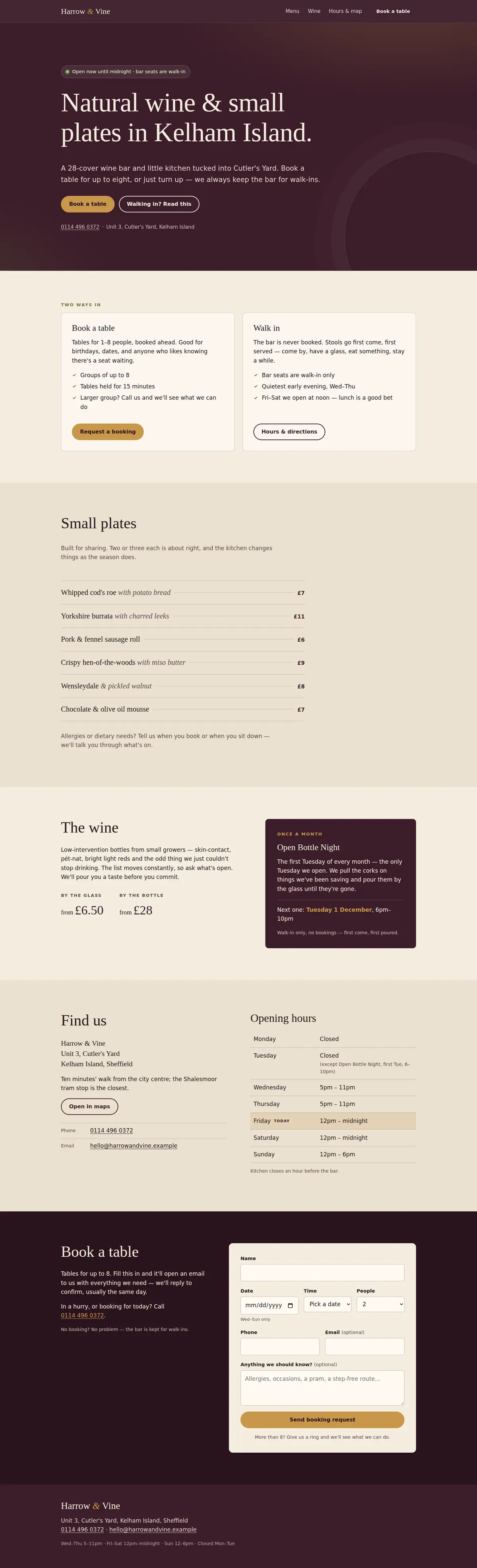
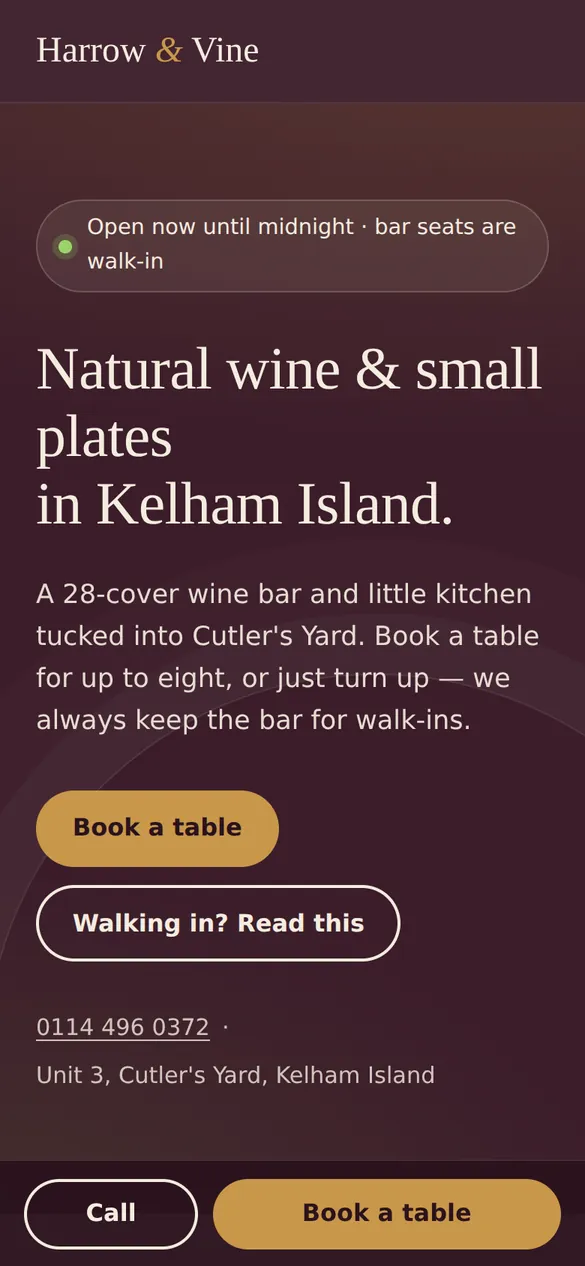
Opus 5.5 alone made the wine-bar page you’ve seen a hundred times: dark plum, a big serif headline, a gold pill button and two faint circles for decoration. Underneath, the work is good. It has the menu and wine prices, an hours table with today marked, a live “open now” badge on UK time, an open bottle night panel that works out the next first Tuesday, and a booking form that opens the visitor’s email app. It took 3 minutes 20 seconds.
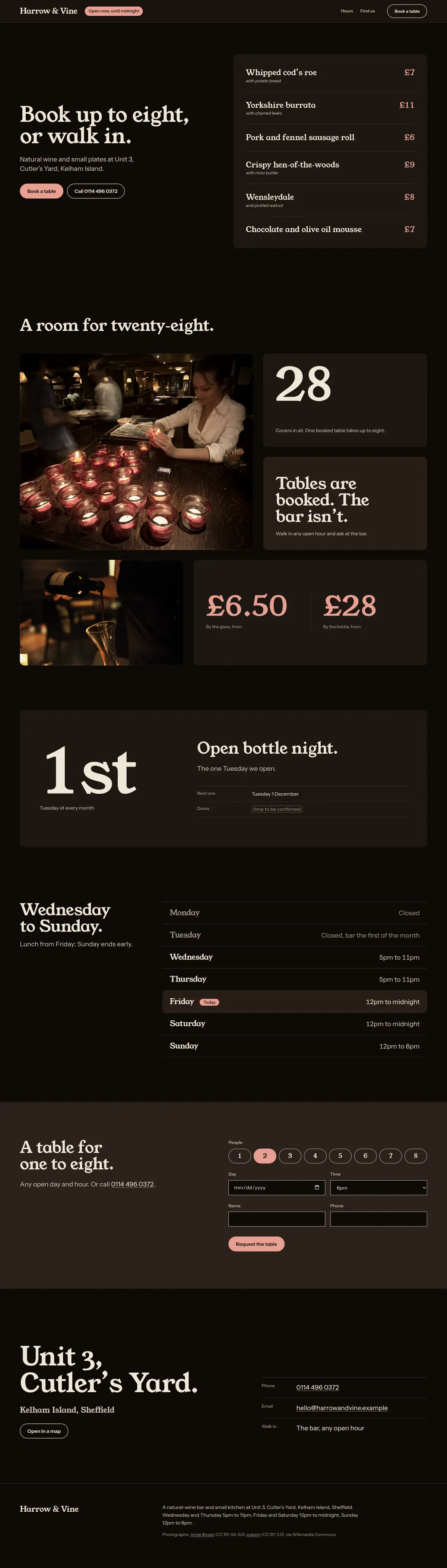
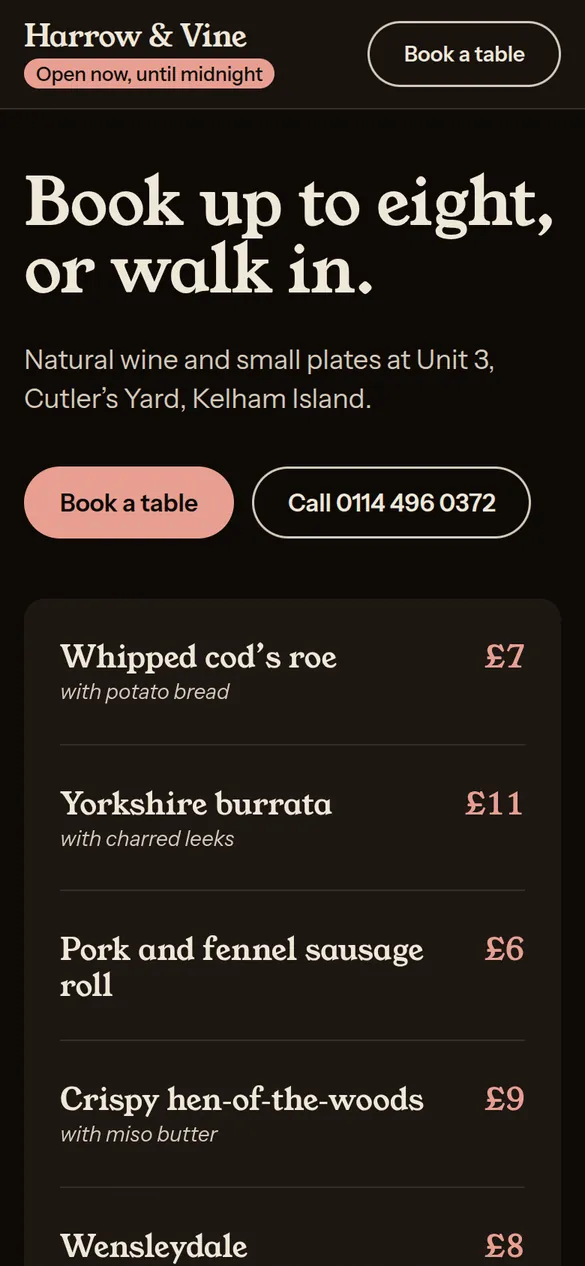
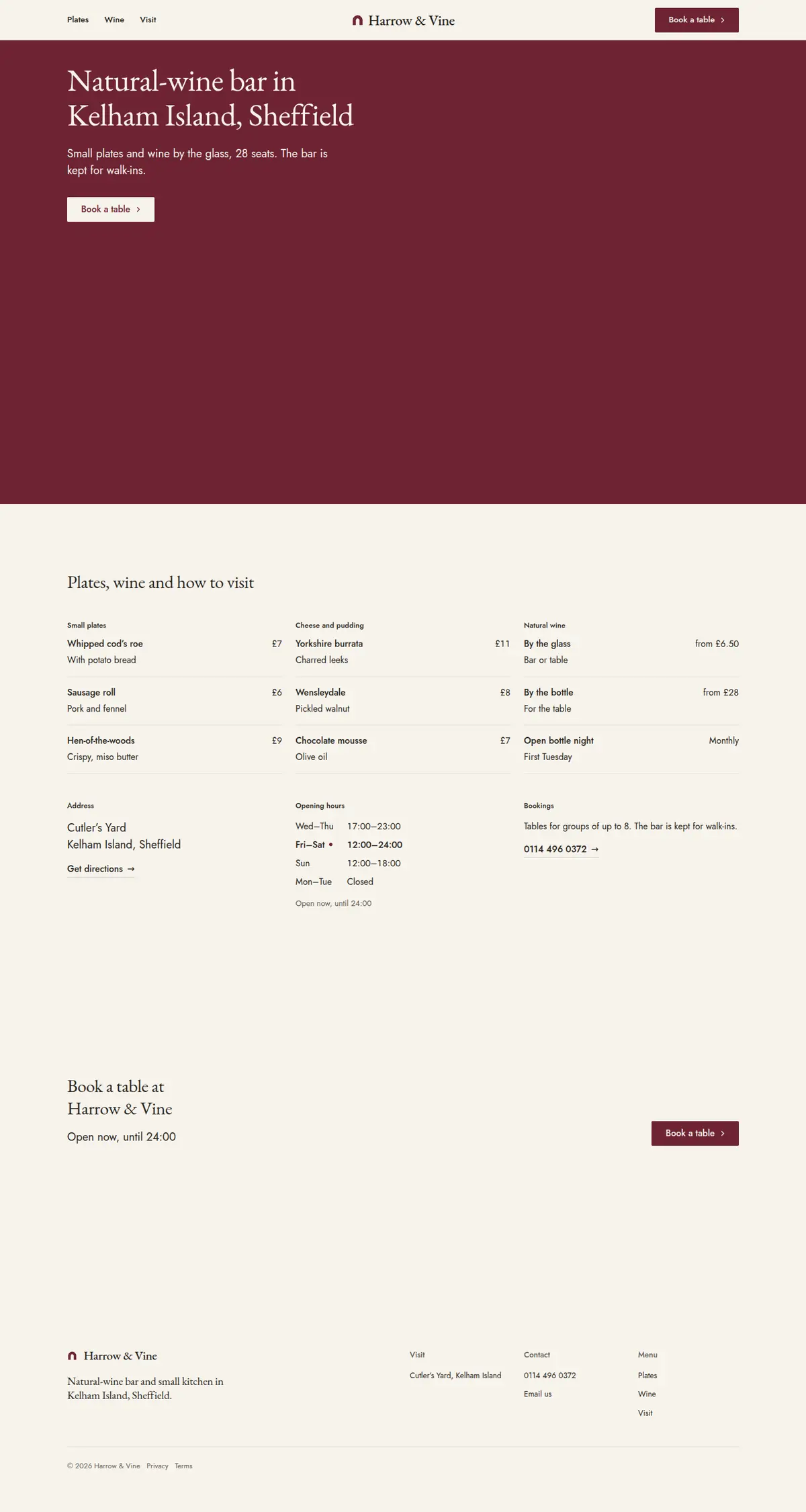
Hallmark put the menu in the first screen and made the booking rule the headline: “Book up to eight, or walk in.” It used two library photos of a candlelit room and a pour, credited in the footer and listed in its handover as stand-ins. The form refuses Mondays and Tuesdays and says plainly that nothing was sent. The brief gives no hours for open bottle night, so Hallmark left a dashed “time to be confirmed” blank instead of making one up.
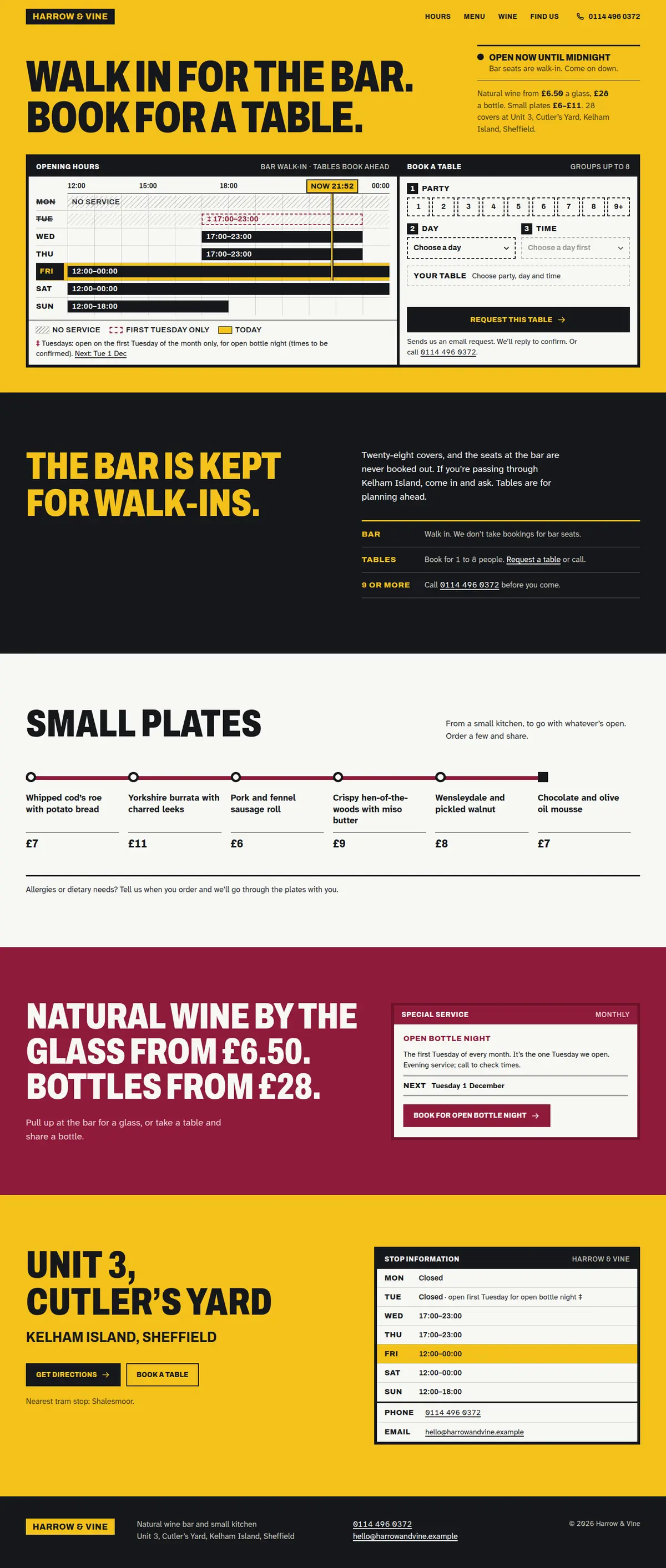
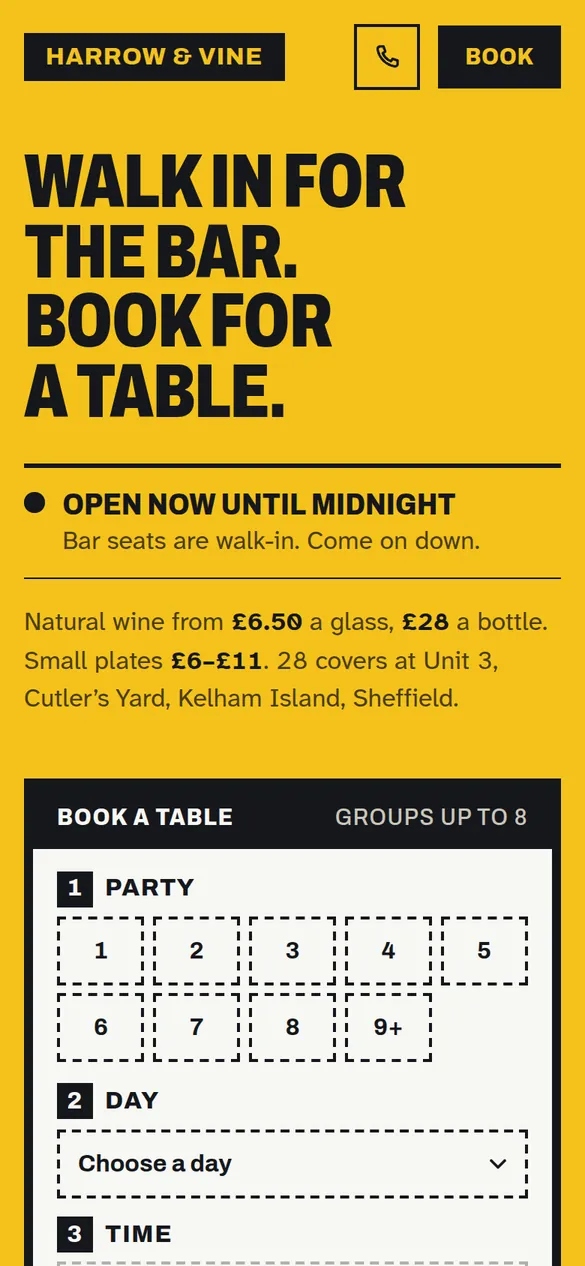
Impeccable treated the site as a timetable, because the question a walk-in has is “when can I just turn up?” The first screen is transport yellow, with the week’s hours drawn as a timetable, a live “now” marker and the booking panel beside it. Further down, the six plates sit as stops on a tram line. It’s the most distinctive of the four, and the only one where the layout itself answers the brief. It made up three things and listed all of them in its handover: open bottle night hours (5pm to 11pm, marked “times to be confirmed” on the page), a last booking time 90 minutes before closing, and the nearest tram stop, Shalesmoor, “from local knowledge; please check it”. The baseline made up the same tram stop, its own open bottle night hours and some house rules, and listed those too.
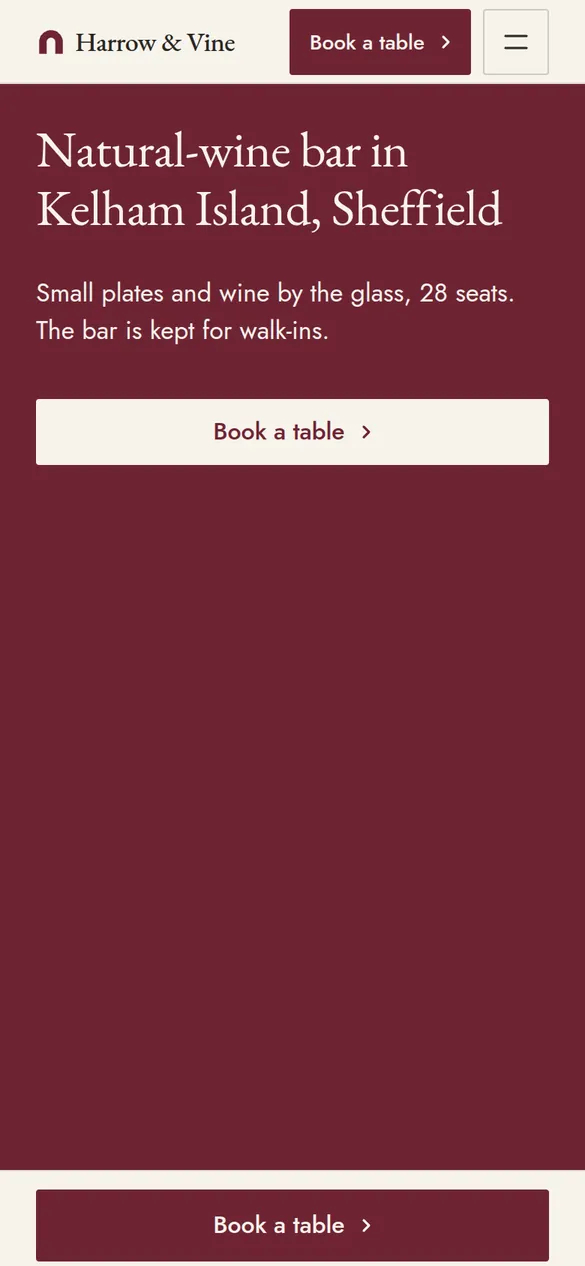
Taste Skill made the weakest page here, and its handover admits the first screen “looks bare at 1440 and is the weakest part of the page”. The agent found nothing in the photo library that it would use for a wine bar (“Rather than show another bar’s room as yours”), so it built the skill’s three-screen short version, and the first screen is an empty oxblood field. Its copy rules also changed facts I gave it. It dropped “Unit 3” from the address, because the skill forbids house numbers (SKILL.md:45, references/copy.md:107), and it turned “28 covers” into “28 seats”. Its own checker still had one failure at the end, which it called a false alarm.
Test 3: an app screen for an incident tool
Build the main dashboard screen for Pagerline, an on-call and incident tool used by a 12-person SaaS engineering team. Desktop web app, one screen. Show: 3 active incidents (SEV1 “Checkout API 5xx spike”, service payments-api, started 14 minutes ago, assignee Priya Nair; SEV2 “Search latency over 2s”, service search, started 52 minutes ago, assignee Tom Becker; SEV3 “Delayed webhook deliveries”, service webhooks, started 3 hours ago, unassigned), this week’s on-call rota (primary Priya Nair, secondary Sam Okafor, handover Monday 09:00), and a health grid for 8 services (payments-api degraded, search degraded, webhooks degraded, auth, web, ingest, billing-worker and notifications healthy). The main action is “Declare incident”. Use realistic fake data only where this brief gives none, and keep it visibly sample data.
Taste Skill 2.5.0 is built for company websites, and the rebuild dropped its old app-screen pipeline, so this test is outside its scope on purpose. I kept it in to see what each skill does with an app screen.
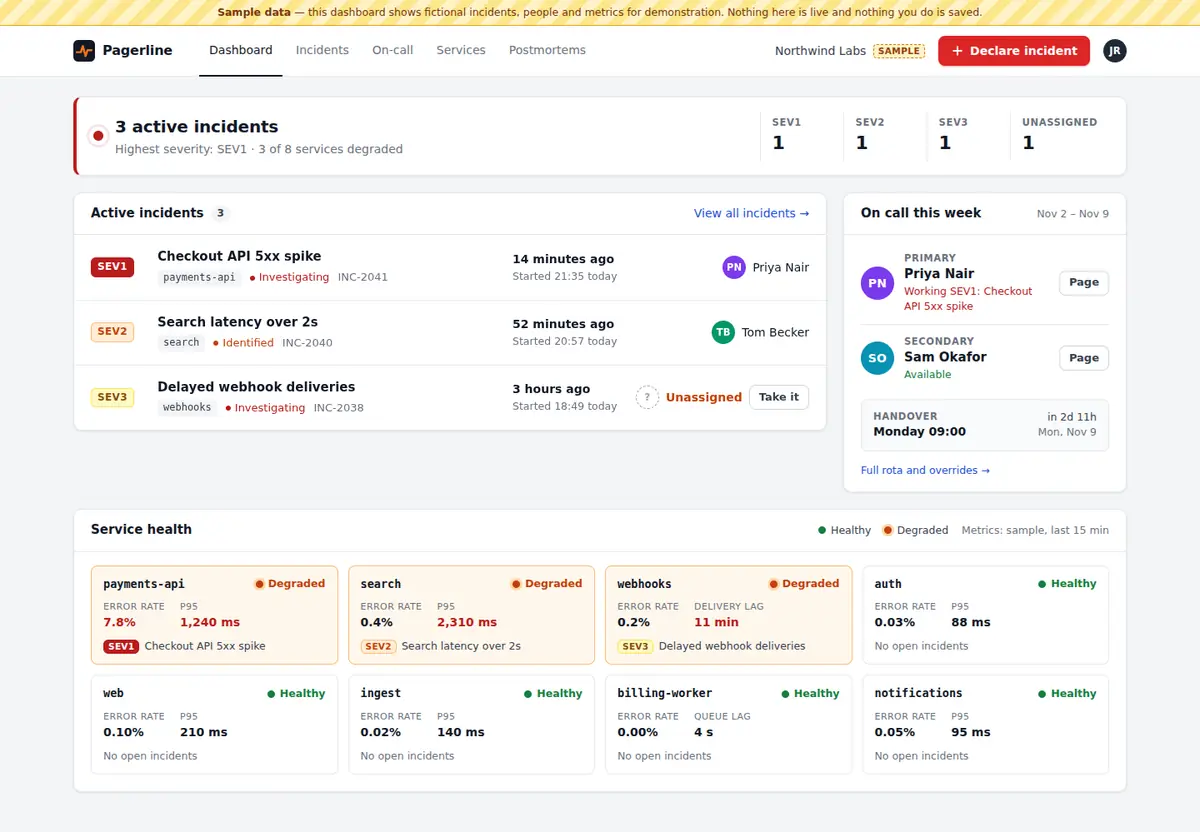
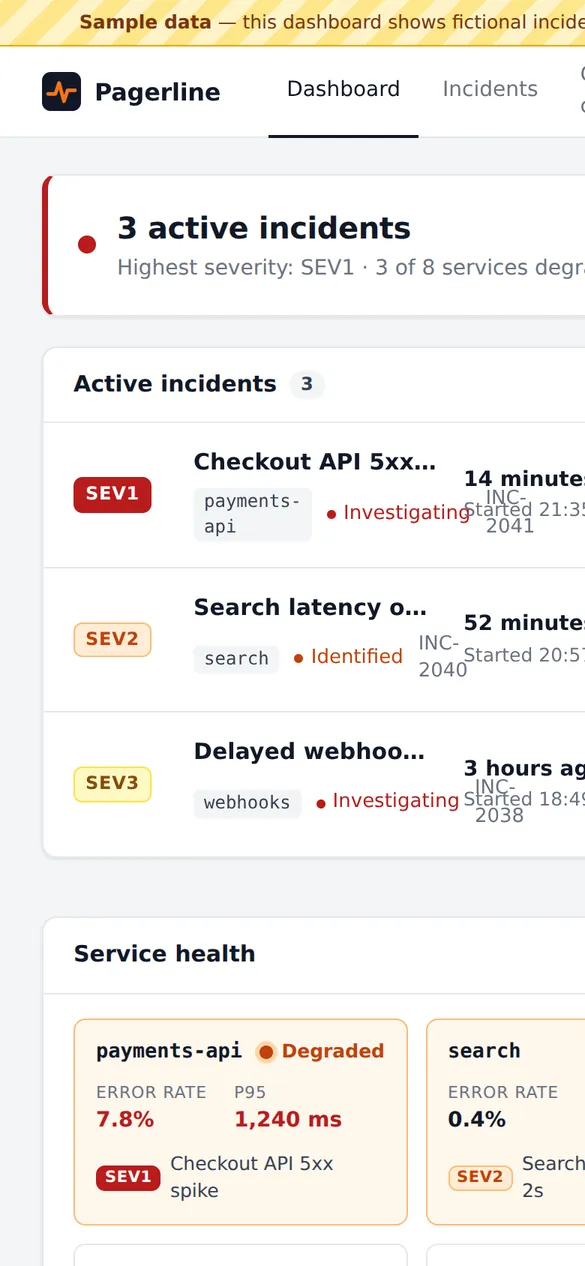
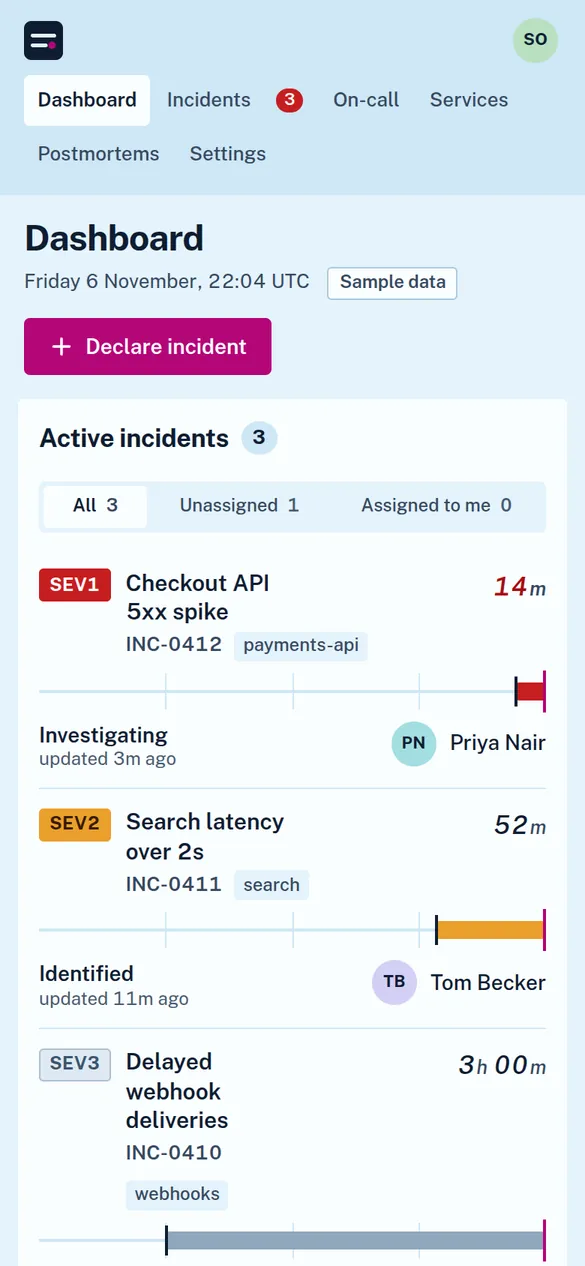
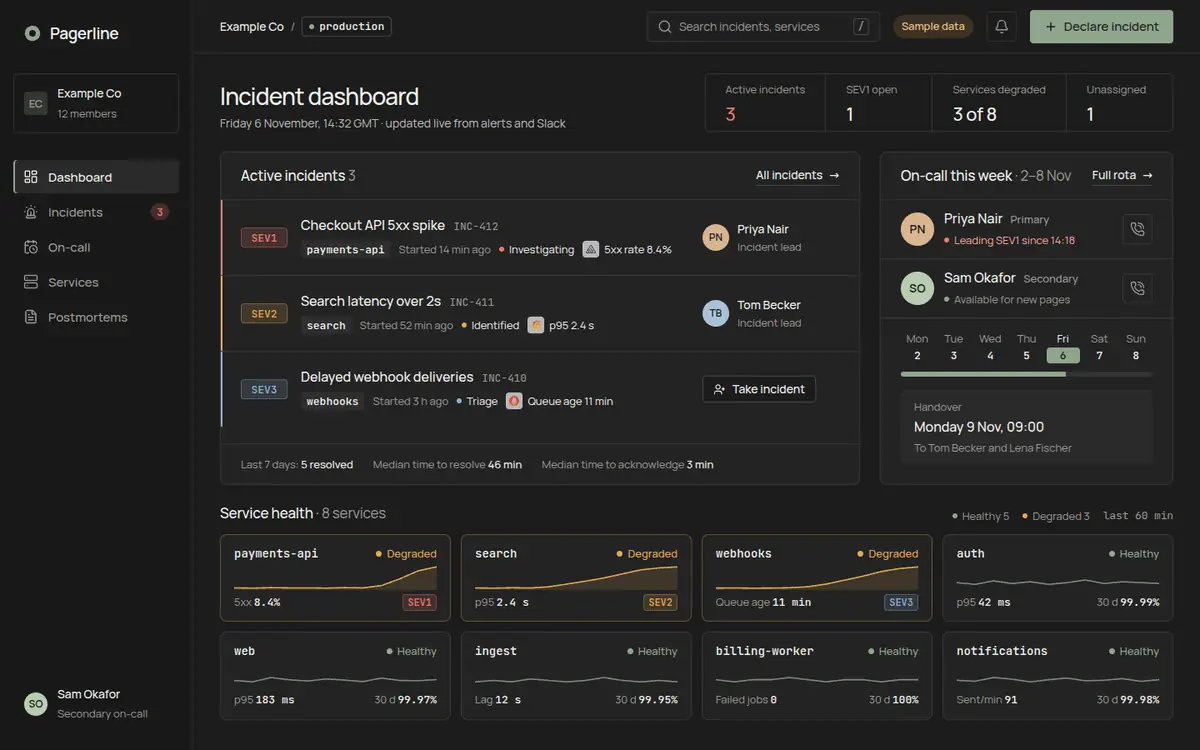
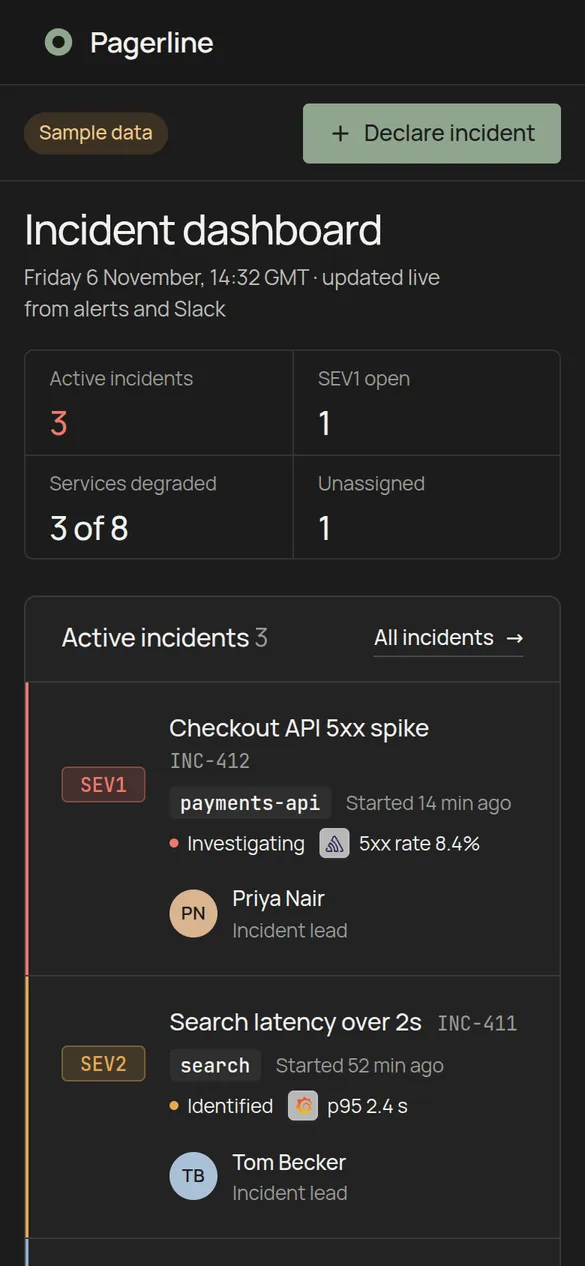
This is the test where the baseline did best. Opus 5.5 alone built a complete, ordinary SaaS dashboard in under 3 minutes for $0.71: a summary strip, the incident list with a “Take it” button on the unassigned SEV3, the rota with a countdown to handover, and a health grid with error rates and p95 latency. It made up those metrics and a workspace called “Northwind Labs”, and labelled all of it with a striped “Sample data” banner. It’s the dashboard every SaaS template already has, but nothing on it is wrong.
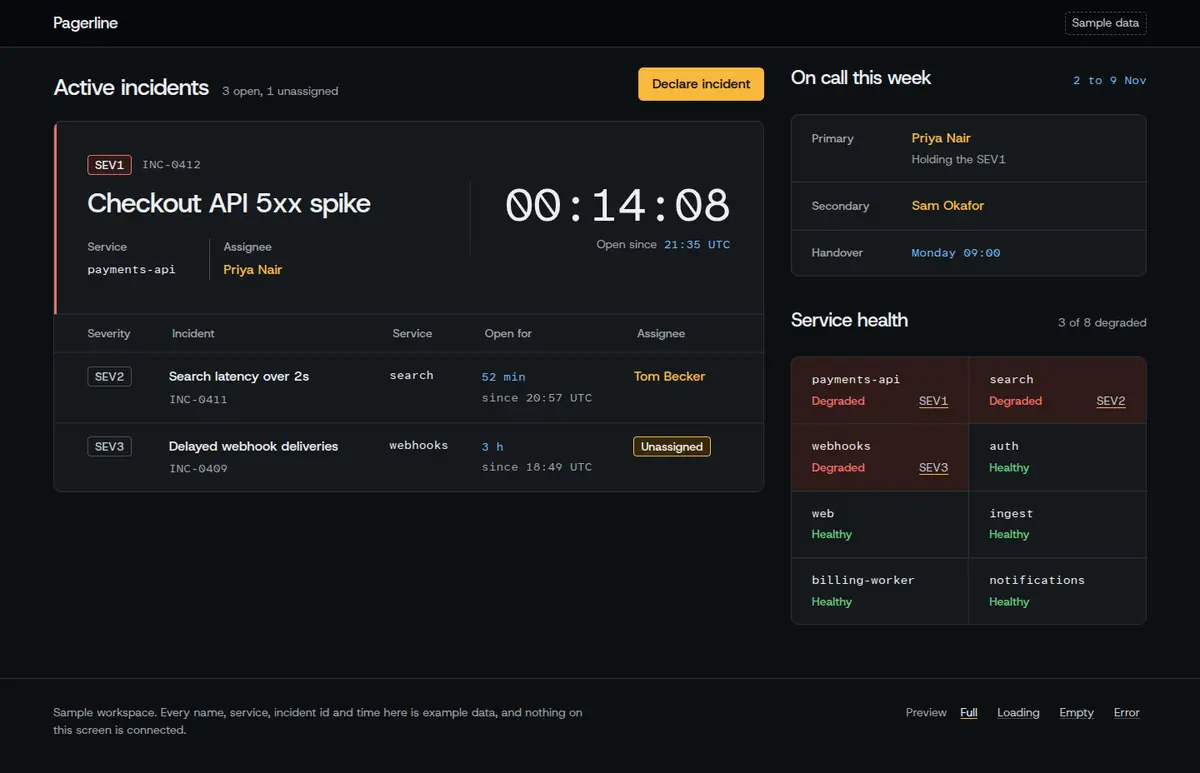
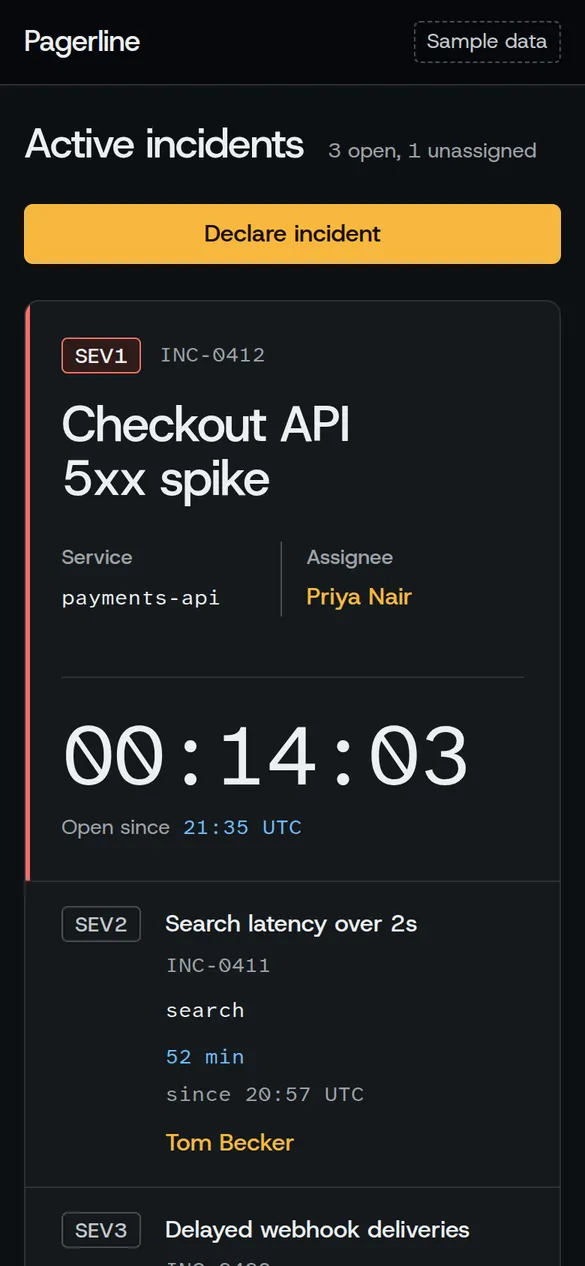
Hallmark went dark graphite and made the SEV1 the hero, with a clock counting up from 14 minutes beside the person holding it. It was the strictest about “use fake data only where this brief gives none”: no error rates, no latency figures, and an assignee list with only the three people in the brief. It also built loading, empty and error versions of every panel, which you can preview with ?state=loading and so on. ROADMAP.md lists “App screens in depth” under Next, but the app scope it has already works.
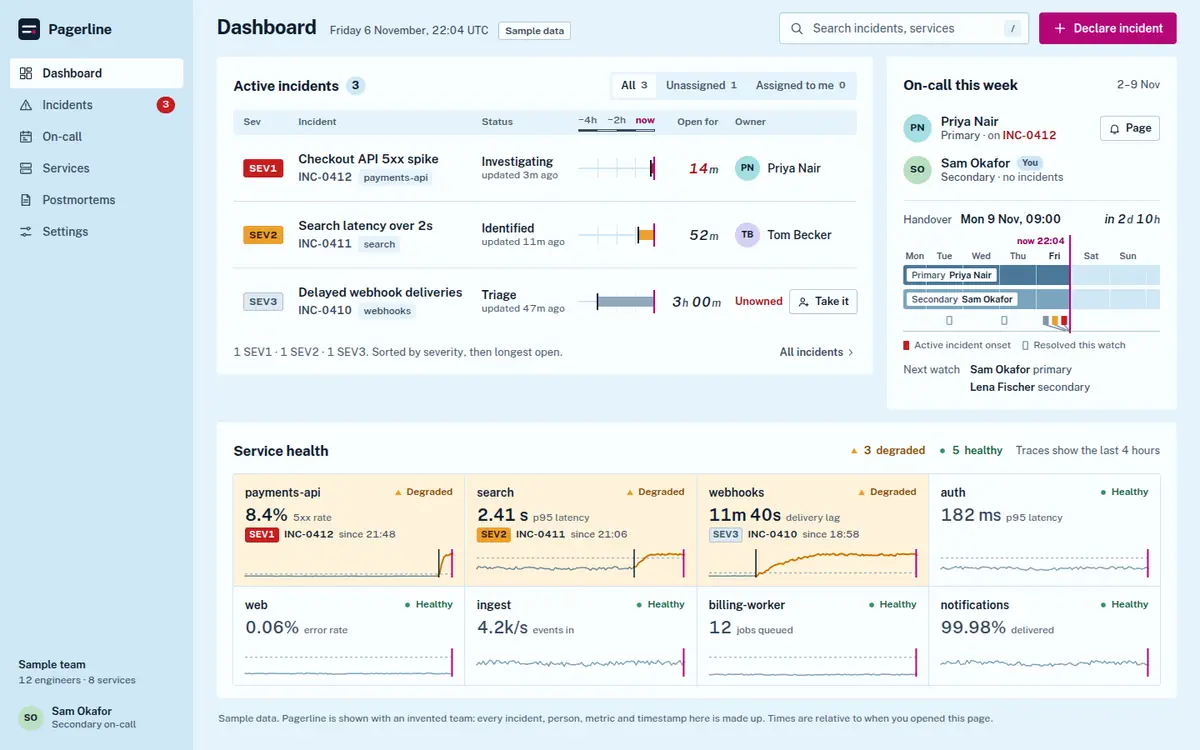
Impeccable drew a random direction from seven candidates and got nautical charts: pale chart blues, magenta for “now” and the main action, and durations set in italic like depth readings. It’s the densest of the four. Incidents have onset bars on a shared four-hour timeline, the rota is a week strip with a “now” line, and each service tile has a small trace with its threshold. Its handover says filters, search, “Take it” with undo and a side panel for declaring an incident all work; I didn’t click through them. It also invented a lot of sample data, including a next week’s rota with a made-up engineer, and labelled it in the header and footer.
Taste Skill did better outside its scope than inside it. The dark charcoal dashboard is polished, with alert-source logos (Sentry, Grafana, Prometheus) and a clean week strip. The skill fought the brief, though. Its checker failed the page on marketing-page rules (a hero, one section per screen, a call-to-action band) and on the “Sample data” pill, because the skill bans sample notes outright (SKILL.md:234). The agent kept the pill, because I asked for it, and skipped the layout checker. It also froze “now” at 14:32 GMT, so the relative times are only right for one afternoon, and the subtitle says “updated live from alerts and Slack” on a screen of sample data.
What the runs cost
Costs are Claude Code’s own estimates at API prices, from each run’s result event. I’m on a subscription, so I didn’t pay them. “Tokens in” includes cached input, which is most of it.
| Test | Setup | Time | Turns | Tokens in | Tokens out | Cost |
|---|---|---|---|---|---|---|
| Tidewell | Opus 5.5 alone | 4m 25s | 25 | 0.8M | 30k | $1.16 |
| Tidewell | Hallmark | 11m 48s | 53 | 5.6M | 69k | $3.96 |
| Tidewell | Impeccable | 23m 09s | 63 | 7.9M | 133k | $6.22 |
| Tidewell | Taste Skill | 2h (cap) | n/a | 47.4M | n/a | n/a |
| Harrow & Vine | Opus 5.5 alone | 3m 20s | 16 | 0.5M | 23k | $0.81 |
| Harrow & Vine | Hallmark | 11m 23s | 60 | 6.2M | 66k | $4.11 |
| Harrow & Vine | Impeccable | 19m 41s | 64 | 6.9M | 113k | $5.34 |
| Harrow & Vine | Taste Skill | 22m 41s | 48 | 4.5M | 36k | $2.72 |
| Pagerline | Opus 5.5 alone | 2m 51s | 11 | 0.4M | 21k | $0.71 |
| Pagerline | Hallmark | 8m 24s | 48 | 3.2M | 50k | $2.81 |
| Pagerline | Impeccable | 20m 39s | 80 | 9.3M | 130k | $6.63 |
| Pagerline | Taste Skill | 22m 48s | 55 | 4.4M | 48k | $2.81 |
A few notes on the numbers:
- The capped run has no result event, so it reported no cost, turns or reliable output count. I counted its input tokens from the stream, once per API call. The same count gives exactly the result-event totals for the other two Taste Skill runs. At the rate of the other two Taste Skill runs, it would come to roughly $29.
- Impeccable runs report in parts. Its reviewer and documenter agents run in the background, so the session sends a result, wakes up when they report, and sends another. I added up the turns across those parts. Each result event carries the same session total for cost, so I used it once.
- The Pagerline Taste Skill run sat idle for about seven minutes at the end, waiting on a watcher the agent had set up for itself that never fired. Its real work took about 15 minutes.
Averaged per page, the baseline took 3.5 minutes and $0.89, Hallmark 10.5 minutes and $3.62, and Impeccable 21 minutes and $6.07. The two Taste Skill runs that finished averaged 23 minutes and $2.77.
Every skill ran its own checks before it handed over:
- Hallmark passed its browser lint with no failures in all three runs, and fresh-context reviewer agents checked each page. In Pagerline, the reviewer raised 8 findings and all 8 were fixed.
- Impeccable ran its detector and a separate reviewer agent each time. The reviewer passed Harrow & Vine as “ship”. On Tidewell its last verdict was still “fix” (for two disclosures the agent then wrote down), and on Pagerline it scored six of seven fixes resolved. All three runs switched off one detector rule, more on that below.
- Taste Skill left one checker failure on Harrow & Vine, which the agent called a false alarm. On Pagerline the checker failed the page on marketing-page rules and the agent skipped the layout check. Tidewell passed the layout check at five sizes, then ran out of time.
What the tests add to the judges’ scores
The judges never ran a build, so this is new evidence. It’s also one run per cell, judged by my eye, so treat it as a strong hint rather than a measurement.
Design quality is where I’d change their order. The judges put Hallmark first for output (8.2), Impeccable second (7.3) and Taste Skill third (7.0). In my runs Impeccable made the most original page every time, and each one was built around an idea taken from the brief: a tide clock for swimmers, a timetable for walk-ins, a chart for an on-call watch. Hallmark’s pages were committed and tidy, with each theme carried through. Its strength showed up as discipline more than ideas. Impeccable’s README calls new builds “that harder mode”, and on this evidence it undersells itself. It costs for it, though: about 1.7 times Hallmark’s money and twice the time.
Hallmark’s honesty rules work. Its Floor says facts that weren’t given stay absent, and in the output they did. It left open bottle night hours blank, put no metrics on the dashboard and listed every stand-in photo. The other two skills made more up, and labelled most of it.
Taste Skill’s problem isn’t scope, it’s rigidity. The judges scored its scope 4.4 out of 10. Yet its weakest page was the wine bar, a business squarely inside its scope, and its dashboard, outside its scope, was fine. What hurt it was its rules: a photo library with gaps, a ban on house numbers that removed one from my brief, a ban on sample labels that clashed with my brief, and a checker strict enough to keep the Tidewell run busy for two hours.
Enforcement looks different in use. The judges rated Impeccable’s enforcement highest (8.9) and Taste Skill’s lowest (6.7). In the runs, Hallmark’s linter was the one the agent obeyed and passed. Impeccable’s detector was overruled on one rule in every run. Taste Skill’s checker was the hardest on the agent, and the least useful to me, because two of its three runs ended with failures the agent had decided to ignore and the third never ended.
For an app screen, you may not need a skill. The baseline Pagerline dashboard was usable, honest about its sample data and done in under 3 minutes. The skills made it more distinctive, but they didn’t make it more correct. On the two marketing pages the gap was much bigger.
Findings worth knowing before you install
The judges reported a lot. These are the findings I checked against the source myself, with links to the pinned commits.
Impeccable phones home for every new design. New work fetches a set of visual directions from the impeccable.style catalog, and by default it also sends an anonymous record of which directions were shown and which one was picked. The README says so (README.md:211), and npx impeccable telemetry off or DO_NOT_TRACK=1 stops the record but not the fetch. All three of my runs printed source: api on that step. The catalog is also the business model: the repo’s own CLAUDE.md calls it “the paid-service moat” (CLAUDE.md:99).
Impeccable’s live mode can start another agent with the sandbox off. If you click Apply in live mode and no chat agent has polled in the last minute, it runs codex (or claude) with --dangerously-bypass-approvals-and-sandbox or --permission-mode bypassPermissions (copy_edit_agent.rs:1524-1552). The README discloses it (README.md:72). Set IMPECCABLE_LIVE_COPY_AGENT=chat or off before you use live mode.
Impeccable’s agent overruled its own detector in every run. The detector flagged “cramped padding” in all three runs, and each time the agent called the rule a false positive and switched it off for index.html in .impeccable/config.json. In one run the reviewer agent measured the screenshots and agreed; in the other two, the agent decided alone. That may be the right call, but it means the agent treats the detector as advice it can overrule.
Hallmark stamps your CSS. Floor rule 15 says “The first non-empty line of the CSS source is the Hallmark stamp” (SKILL.md:34). Every Hallmark run started its stylesheet with one, recording the theme and the deal seed, and on the two marketing pages the page’s job. Add its absolute bans on eyebrow labels and tracked capitals, and its linter will flag a lot in a codebase it didn’t write. Its own description says not to use it on an existing design unless you name it.
Hallmark’s evals aren’t checkable. It has a real harness in eval/ (briefs, a model matrix, lint scoring, a vision judge), but eval/.gitignore excludes runs/, so no results are in the repo. Its CI (verify.yml) also doesn’t run the linter’s tests. DeepSeek was the only judge to spot that.
Hallmark pages hotlink their photos. The Tidewell and Harrow & Vine pages load their pictures from upload.wikimedia.org and their fonts from Google Fonts. The credits are right there in the footer, but you’ll want to host both yourself before launch.
Taste Skill’s README describes a redesign route that 2.5.0 removed. README.md:159 says redesign is part of the skill and “audits an existing page in a real browser before changing anything”. The 2.5.0 SKILL.md has no such route, and the CHANGELOG says the rebuild replaced the 2.1.x pipeline. Four of the five judges caught this on their own.
Taste Skill has almost no tests. tests/ holds two files, frontmatter.mjs and text-encoding.mjs. The 10,140-line checker has no behaviour tests, and CI runs those two files and parses the scripts. Its layout reference cites “a study of 327 sites” (layout-v4.md:16) with no data behind it.
Taste Skill’s fact rules point both ways. It drops a house number you gave it, as above, but it allows “on a place, plausible hours and prices” that you didn’t give it (SKILL.md:150). Hallmark’s Floor is the opposite: facts that weren’t given stay absent.
All three are heavy on context. Taste Skill makes the agent read four references in full before the first page, about 100 KB. Hallmark loads about 100 KB per build. Impeccable’s core SKILL.src.md is small at 12.7 KB, but new-work.md alone is 64 KB, and Impeccable’s own fidelity report (COMP-FIDELITY.md) counts 183 KB of skill text read before the first write. The token column in the table above is where that shows up.
Which one to use
In an existing product codebase, use Impeccable. This is the judges’ strongest call and I didn’t test it, because all my briefs were new builds. init and document give every later command your product and design system, critique and audit review what’s there, and the detector runs in CI. Before you use it, turn telemetry off if you mind it, and set IMPECCABLE_LIVE_COPY_AGENT=chat before you try live.
For a new marketing page, it depends on what you’re short of. If you want the boldest page and can spend about $6 and 20 minutes on it, use Impeccable. If you want the facts kept straight, a clean lint and about 60% of the cost, use Hallmark, then host its photos and fonts yourself before launch.
For a quick internal app screen, Opus 5.5 alone is fine. Use Hallmark or Impeccable if it has to look like a product rather than a template.
Skip Taste Skill for now. Version 2.5.0 was a day old when I tested it, its README still promises a feature it removed, its rules removed a fact from one brief and fought another, and it has almost no tests. It has a big, interesting asset kit, so I’d look again once it settles.
I kept the raw runs, prompts, stream-json logs and screenshots for all 12 builds. The briefs above are complete, so if you have an afternoon and a subscription, you can run the same test yourself.